Public perceptions of healthcare systems often blend various models, but understanding the specific concept of socialized medicine reveals a distinct approach to organizing health services. This system involves government ownership and operation of healthcare facilities, as well as employment of medical professionals, ensuring that all medical services are publicly funded. This comprehensive model aims to provide universal access to healthcare, reducing disparities and controlling costs through government management.
How Does Socialized Medicine Differ From Other Healthcare Models?
While frequently confused with similar concepts like universal coverage or single-payer healthcare, socialized medicine maintains unique characteristics. Universal healthcare simply guarantees that all individuals have access to medical services, which can be achieved through mixed public-private systems. Single-payer healthcare involves a government fund covering medical expenses, but the actual delivery can still occur via private providers. In contrast, socialized medicine entails the government owning and operating the healthcare infrastructure and directly employing healthcare workers, creating a fully public system.
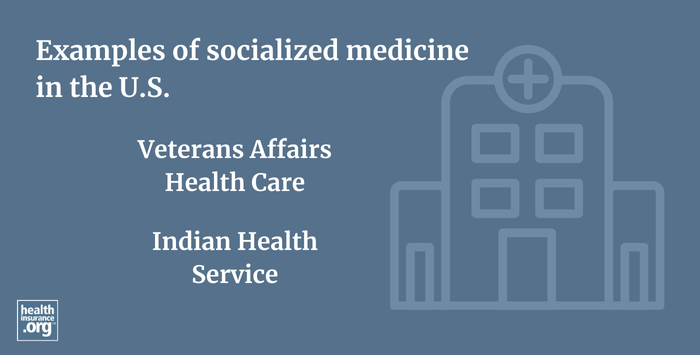
For instance, the British National Health Service (NHS) exemplifies socialized medicine, as it funds healthcare through taxation and employs medical staff directly. Residents can opt for private healthcare if they choose, but such options are less common. Similarly, in the United States, the Veterans Health Administration functions as a form of socialized medicine, providing care to eligible veterans through government-operated facilities. The Indian Health Service (IHS) offers another example, with government-owned facilities serving American Indians and Alaska Natives, though its scope is limited geographically and demographically.
In essence, the key distinction lies in the ownership and employment structure—socialized systems feature government-run facilities and staff, whereas other models might rely on private providers funded by public money.
Is Obamacare An Example of Socialized Medicine?
No, the healthcare coverage established under the Affordable Care Act, commonly called Obamacare, does not qualify as socialized medicine. Instead, it represents a regulated market-based approach where private insurance companies provide coverage through government-established exchanges. These plans are sold by private insurers such as Anthem, Kaiser, and Cigna, and the participating hospitals and doctors are privately operated entities. The government’s role is primarily regulatory, setting standards for coverage and offering subsidies to help eligible individuals afford insurance.
Interesting:
- Understanding in network and out of network providers how choices impact your healthcare expenses
- Understanding the significance of snomed ct in modern healthcare
- Understanding canadas single payer healthcare system insights from a canadian physician
- Understanding the structure and function of canadas healthcare system
The regulations ensure that health plans cover essential health benefits, pre-existing conditions, and prevent annual or lifetime caps, but the ownership and operation of healthcare providers remain private. Therefore, Obamacare is not equivalent to socialized medicine, which involves direct government ownership and employment of healthcare providers.
In the U.S., the Medicare program is a notable exception. It is a federally funded, single-payer system that covers approximately 68 million people. However, because Medicare primarily pays private hospitals and physicians rather than owning or employing them, it does not fall under the strict definition of socialized medicine. Similarly, Medicaid provides public coverage to nearly 80 million Americans, but involves joint federal and state funding, with providers remaining privately employed.
How Widespread Are Single-Payer and Universal Healthcare Systems?
Globally, the adoption of healthcare models varies considerably. According to data from World Population Review, only 17 countries operate under a true single-payer system, where the government finances and administers all healthcare services. In contrast, a larger number—78 countries as of 2024—offer universal healthcare coverage, often through a blend of public and private providers and funding sources. Notably, the United States is the only high-income country that does not yet have universal coverage, either through a single-payer or mixed system.
Most countries that provide universal healthcare do so with a mix of government and private sector involvement, which enables broad access while maintaining operational flexibility. These systems prioritize ensuring that their populations can access necessary medical services without the direct ownership of healthcare facilities by the government, differentiating them from fully socialized models.
Related Articles and Resources
- Explore how American Indians and Alaska Natives can access coverage under the ACA, including specific plan options and eligibility criteria.
- Learn about how virtual reality and other innovative technologies are transforming healthcare delivery and improving patient outcomes by advancing pharmaceutical visualization.
- Discover how cutting-edge XR technologies are bridging gaps in medical practice and revolutionizing modern medicine by integrating immersive solutions.
Understanding the nuances of socialized medicine and its alternatives helps clarify ongoing debates about healthcare reform worldwide. Whether through fully government-run systems or hybrid models, the goal remains the same: providing accessible, affordable, and quality healthcare for all.